

China is the global core market of new energy vehicles, and its industry has stepped into a golden period of large-scale and rapid growth. The penetration rates of electrification, intelligence and connectivity are continuously rising, showing strong market development momentum. According to data from the China Association of Automobile Manufacturers, China’s new energy vehicle sales reached 1.892 million units in the first quarter of 2026, with a year-on-year increase of 35.7% and a month-on-month growth of 12.3%. China has ranked first in global production and sales volume of new energy vehicles for eight consecutive years, and keeps releasing vigorous market growth vitality.

Compared with traditional fuel vehicles, new energy vehicles witness a dramatic rise in the complexity of electronic systems involving power systems, intelligent driving, on-board electronic control, vehicle networking interaction and body electronic control. This directly fuels sustained growth in demand for automotive PCBs, making automotive PCBs the core new growth engine for China’s PCB industry following AI servers. Meanwhile, the accelerated commercialization of AI technology has been deeply integrated into the whole process ranging from PCB design, manufacturing to quality inspection. The combined effect with new energy vehicle demand further promotes quality improvement, efficiency upgrading and iterative evolution of China’s PCB industry, helping domestic PCB enterprises overcome high-end technical bottlenecks.
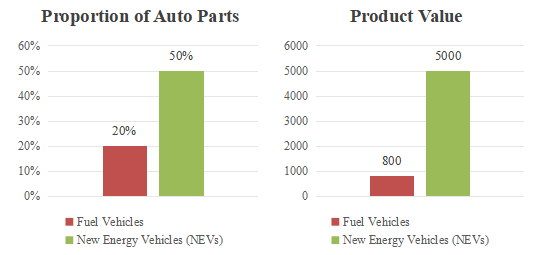
The incremental demand for PCBs driven by new energy vehicles mainly originates from the substantial growth of per-vehicle PCB value, which is particularly prominent in China’s market. Based on authoritative industrial data, in terms of product structure comparison, PCBs applied in traditional fuel vehicles are mainly basic on-board circuits, accounting for 15% to 20% of total vehicle electronic components, with a per-vehicle value of merely 500 to 800 yuan, which conforms to the low electronicization rate of traditional fuel vehicles.
By contrast, PCBs of new energy vehicles are extensively applied in full-scenario electronic systems, accounting for 45% to 50% of total vehicle electronic components, with a per-vehicle value of 3,000 to 5,000 yuan, 5 to 10 times that of traditional fuel vehicles. Such value level matches the actual configuration of three-electric systems and intelligent cockpits equipped on smart electric vehicles, and is highly consistent with the order performance of automotive business from leading domestic PCB enterprises.
Specifically, a great number of electronic components on new energy vehicles, including power battery management system, motor electronic control, on-board charger, high-voltage power distribution unit, advanced intelligent driving domain, multi-camera radar modules, in-vehicle entertainment cockpit and body domain controller, raise comprehensive requirements for PCBs in circuit layers, circuit density, high frequency, high voltage and high reliability. This directly triggers explosive demand for high-end PCB products including high-voltage thick copper boards, high-layer PCBs, high-frequency high-speed boards, flexible PCBs and rigid-flexible PCBs.
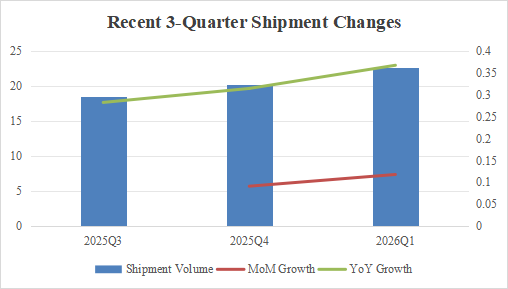
In terms of China’s PCB industry shipment statistics, automotive PCB output has maintained steady growth in the past three quarters, which is strongly correlated with the sales growth of new energy vehicles. Revised in combination with industrial prosperity and order data of leading enterprises, the detailed data are as follows: China’s automotive PCB shipments hit 1.86 billion pieces in the third quarter of 2025, a year-on-year increase of 28.3%; the figure rose to 2.03 billion pieces in the fourth quarter of 2025, up 31.5% year on year and 9.1% month on month.
Benefiting from the explosive sales growth of new energy vehicles, automotive PCB shipments further climbed to 2.27 billion pieces in the first quarter of 2026, representing a year-on-year growth of 36.8% and a month-on-month increase of 11.8%. Among them, the year-on-year growth rates of shipments for high-voltage thick copper boards and rigid-flexible PCBs both exceeded 40%, which is in line with the 35%-45% growth rate of high-end automotive product orders among domestic leading PCB enterprises. These high-end products have become core categories driving PCB shipment growth, adapting to the high-end and large-scale development trend of automotive PCBs.
The positive impact of civilian-oriented AI technology on China’s PCB production is extremely remarkable, which acts as a key support to solve industrial pain points and enhance core competitiveness. Revised according to actual intelligent production data of the PCB industry:In the design link, AI algorithms can rapidly complete layout optimization of complex automotive PCBs (such as rigid-flexible boards and multi-layer high-voltage boards), shortening the design cycle by over 30% and reducing design errors by 80%, and precisely meeting the miniaturization and high-density demands of new energy vehicle electronic systems.
In production, AI visual inspection can accurately identify circuit defects, hole wall flaws, uneven plating and other problems. Its detection efficiency is more than 10 times higher than manual inspection, controlling the defective rate of PCB products below 0.5% to satisfy stringent automotive-grade quality requirements, which is consistent with the application effect of AI inspection among top domestic PCB enterprises.
In process control, AI realizes real-time monitoring of key procedures including lamination, drilling and etching, and conducts dynamic adjustment and optimization to improve production stability. It helps domestic PCB enterprises achieve large-scale and high-precision mass production, while cutting labor costs by 20% to 30% and material loss by more than 15%, conforming to actual benefits of intelligent transformation in the PCB industry. In addition, AI-powered intelligent production lines can flexibly adapt to diversified PCB switching production, meeting customized demands of different new energy vehicle models and electronic components, and improving market adaptability and core competitiveness of domestic PCB enterprises.
Meanwhile, harsh service conditions of automotive scenarios drive technological iteration and upgrading of China’s PCB products. Automotive PCBs need to adapt to harsh working conditions for a long time, including alternating high and low temperatures, vibration impact, moisture corrosion, high-voltage insulation and long-term reliability. Higher standards are thus put forward for substrate performance, lamination process, hole wall quality, plating stability, flame retardant grade and dimensional stability.
High-voltage high-current thick copper process, high-temperature resistant substrates, high-reliability surface treatment, multi-layer precise interconnection and integrated rigid-flexible process have become core technical directions for automotive PCB manufacturing. This forces the domestic PCB industrial chain to optimize production processes, improve process precision and quality management capacity, while the application of AI technology provides efficient support for such upgrading, accelerating the high-end transformation of domestic PCB products.
From the perspective of industrial development pattern, sustained output growth of China’s new energy vehicles, accelerated overseas expansion of domestic automobile enterprises, speeding-up localization substitution of automotive electronics, together with efficiency improvement brought by civilian AI application, jointly ensure strong long-term growth certainty of China’s automotive PCB market.
At present, the demand structure of China’s PCB industry is continuously optimized, with tight production capacity of high-end automotive PCBs. Domestic PCB enterprises that possess stable mass production capacity, full-category process coverage, strict quality management system and take the lead in deploying AI intelligent production will seize larger market shares, and gradually break the monopoly of foreign enterprises in the field of high-end automotive PCBs.
In the future, with the popularization of advanced intelligent driving, continuous improvement of on-board electronic integration, and in-depth application of AI technology in PCB production, the demand dividend of China’s PCB industry will continue to be released. For domestic PCB enterprises, focusing on process upgrading in automotive field, integrating AI to realize intelligent production and high-end product development, and empowering China’s new energy vehicle industrial chain with high-precision, high-reliability and highly adaptable PCB products will become an important layout for expanding growth tracks, building diversified core competitiveness and achieving high-quality development.