

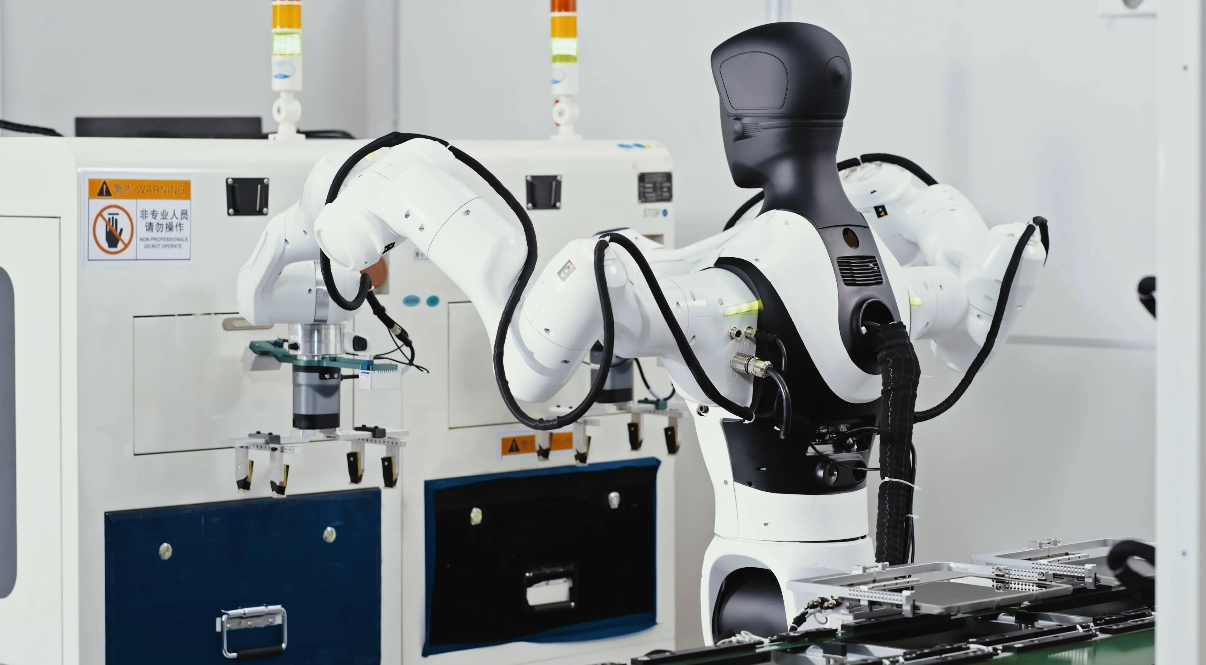
As China accelerates its leadership in Artificial Intelligence and "New Quality Productive Forces," the boundary between digital intelligence and physical action is blurring. The rise of Embodied AI and massive AI computing clusters demands hardware that can handle unprecedented data throughput and power density. At Asinda Circuits, we are at the forefront of this revolution. By mastering the manufacturing of high-multilayer PCBs, we provide the critical physical infrastructure for AI servers and high-performance computing. We bring this same level of extreme precision and reliability to robotics, creating the "nervous system" that bridges high-performance computing (HPC) with precision motion.
The Core Carrier of Robotics: Precision, Power, and Integration
Robotics PCBs act as the central nervous system for sensing, algorithm processing, and motion execution, differing fundamentally from conventional commercial PCBs. They must integrate high-current power electronics, precision sensor modules, and high-speed control circuits within limited spaces. This imposes stringent requirements on compact layout, thermal performance, mechanical stability, and anti-interference capabilities.
Comprehensive Functional Integration
A standard robotics PCB is a marvel of integration, covering sensor interfaces (IMUs, cameras, encoders), real-time processing units (MCUs, FPGAs, and increasingly, edge AI chips), motor drive power circuits, and communication ports like Ethernet, CAN, and wireless modules. To ensure the coordinated operation of these functional units, modular layout, standardized grounding, and rigorous signal isolation are essential to prevent crosstalk. Compared with ordinary boards, robotics PCBs feature higher current load capacity, optimized thermal design, superior mechanical durability, andstricter analog-power noise suppression.
Thermal Management & Miniaturization
Thermal management is the primary design priority for robotics applications. Heat dissipation is realized via complete copper planes, thermal via arrays, matched heat sinks, and chassis conduction paths. We utilize rational component layout and thermal simulation verification to stabilize performance under high-power operating conditions. For size-sensitive scenarios like drones and mobile robots, we apply HDI technology, microvias, and fine-pitch components. Furthermore, rigid-flex PCB solutions are widely deployed in industrial robot joints to realize 3D miniaturized packaging, allowing for dynamic movement without signal failure.
Ruggedized for Complex Environments
Robotics PCBs must adapt to complex environments characterized by vibration, dust, and drastic temperature fluctuations. We enhance environmental adaptability through conformal coating, locking connectors, and reinforced mounting structures. Compliant with IPC-A-600 and IPC-6012 workmanship criteria, our standardized creepage and clearance designs guarantee high-voltage operational safety. To protect high-precision sensor signals from electromagnetic interference, we adopt strict partitioning of analog and power domains, complete ground planes, and short signal return paths.
Manufacturing Excellence & Validation
In terms of manufacturing and validation, the coexistence of high-current motor circuits and weak sensor signals raises higher demands on stack-up design and DFM (Design for Manufacturability) optimization. Our early electrical-mechanical collaborative design process avoids assembly and dimensional mismatches. We employ AOI, in-circuit testing (ICT), load functional testing, and hardware-in-the-loop verification to guarantee field reliability before the product ever leaves our facility.
Asinda Circuits: Your Partner in Robotics & High-End Innovation
Asinda Circuits provides comprehensive PCB solutions ranging from 4–16+ layer robotics boards to high-multilayer (up to 32L) AI infrastructure boards. Our expertise covers high-Tg substrates, low-loss laminates, and 2oz+ heavy copper designs. We fully support rigid-flex structures, impedance customization, and full-process DFM review. From prototype to mass production, we empower our customers to achieve seamless iteration with high stability, reliability, and cost-effectiveness.